Course Description
The word tharva means to tremble. A-tharva is that which does not tremble. It is that which is without fear because it is without ignorance. The Atharva Veda and every text that belongs to its lineage carries this as its deepest promise: that through right knowledge, the one who studies arrives not at comfort, but at the fearlessness that belongs to Brahman itself.
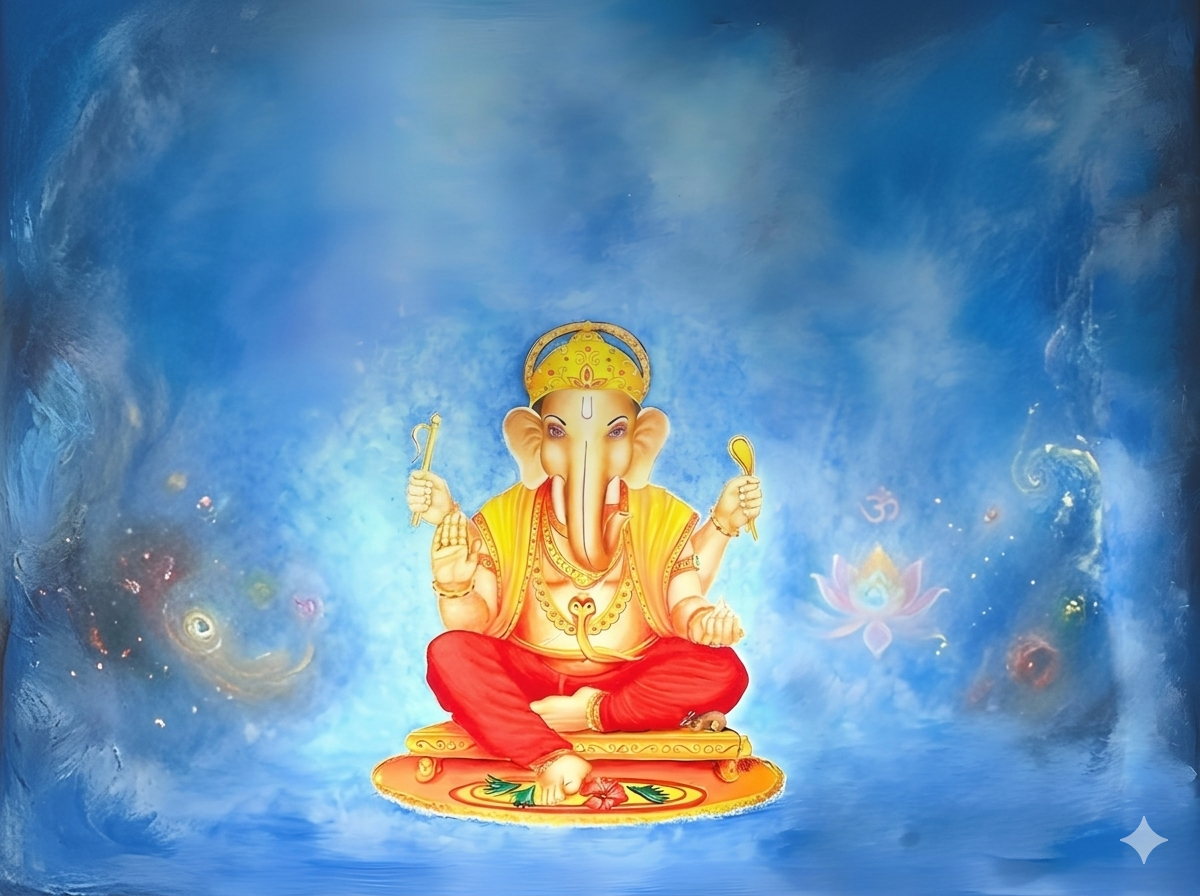
The Gaṇapatī Atharvaśīrṣa is an Upaniṣad within this lineage. In it, Gaṇapatī is not presented as one deity among many but as the ground of all consciousness, all speech, all manifestation. The text moves through an identification of Gaṇapatī with Sat-Cit-Ānanda, with the four levels of vāk, with the three guṇas and what lies beyond them, with Om. It reveals the bīja mantra gaṃ. It concludes with the Phalaśruti, the fruits of correct recitation, among them vāgmitā, mastery of speech, and vidyā, knowledge. And in its closing verse, it offers what the entire text has been building toward: one who understands Brahman and its veiling power does not fear at any time.
This is not a popular text about the elephant-headed remover of obstacles. It is a text about the nature of reality, transmitted in the form of sound.
Within the tradition of Vedic chanting, the Gaṇapatī Atharvaśīrṣa is where serious study begins. It is the first complete Upaniṣadic text most sādhakas learn to chant, and it is taught here as it has always been transmitted: orally, incrementally, and with the full rigour of śikṣā, the Vedic science of phonetics that governs correct utterance across its six dimensions: varṇa, svara, mātrā, balam, sāma, and santāna. Pronunciation here is not a technical concern. It is the condition under which the text functions as it was always intended to.
Course Information
-
Across seven live classes, the complete Gaṇapatī Atharvaśīrṣa is built section by section through oral transmission. Alongside the chanting practice, each class includes a contextual study of the text: its place within the Atharva Veda, the structure of the Upaniṣad, the meaning of its key passages, and the significance of the Phalaśruti. Śikṣā is taught not as a separate module but woven through every session, so that the rules of correct recitation are understood in practice rather than in theory.
By the final class, you will hold the complete text and have the foundation to sustain it in your own sādhana.
-
This course is for practitioners who come with some prior exposure to Sanskrit and a genuine orientation toward knowledge. You do not need to have studied this text before. You do need to come with the quality of inquiry that makes transmission possible, an earnest engagement with the subject, and a willingness to learn correctly rather than quickly.
-
7 classes
Wednesdays, 4-5 pm
July 22, July 29, Aug 5, (no class Aug 12), Aug 19, Aug 26, Sept 2, Sept 9.
FAQs
-
It is an Upaniṣad from the Atharva Veda tradition. Tharva means to tremble; a-tharva is that which is without trembling, without fear. This fearlessness is not psychological. It is the fearlessness of one who has arrived at knowledge of Brahman, which the text identifies with Gaṇapati directly. It is one of the most widely chanted Upaniṣads in India and, within the tradition of Vedic chanting, it is the text through which most sādhakas enter serious study of sacred chant. Short enough to be held in memory, it is vast enough to study for a lifetime.
-
Some prior exposure to Sanskrit is helpful, particularly a familiarity with Sanskrit sounds and the ability to follow a text. This course is not designed for those entirely new to Sanskrit. It is designed for practitioners who are ready to deepen, those who have been chanting mantras and want to understand what correct chanting actually requires, or those who have studied Sanskrit and are ready to bring it into living practice.
-
Śikṣā is the Vedic science of phonetics, one of the six Vedāṅgas, the limbs of the Veda. It governs the precise conditions of sacred utterance: the quality of each phoneme, its tonal accent, its duration, its force, its evenness, and its continuity. In the Vedic understanding, the potency of a mantra and the accuracy of its pronunciation are not two separate things. To learn with śikṣā is to learn as the tradition has always transmitted, with complete fidelity to the sound.
-
Yes. The text is built incrementally across all seven classes, with each session reinforcing what has come before. By the final class, you will have the complete Gaṇapatī Atharvaśīrṣa, not only memorised but understood in its structure and meaning, and the foundation to maintain it independently.
-
No. It is for any practitioner with some Sanskrit background and a genuine interest in studying this text correctly. Whether you are a yoga teacher, a long-term sādhaka, or someone for whom this text has called, the course is open to you.
-
Yes. All live classes will be recorded and made available for a limited time, so you can return to the material and practice between sessions.
-
Register using the button below. You will receive joining details and any preparatory guidance ahead of the first class.