
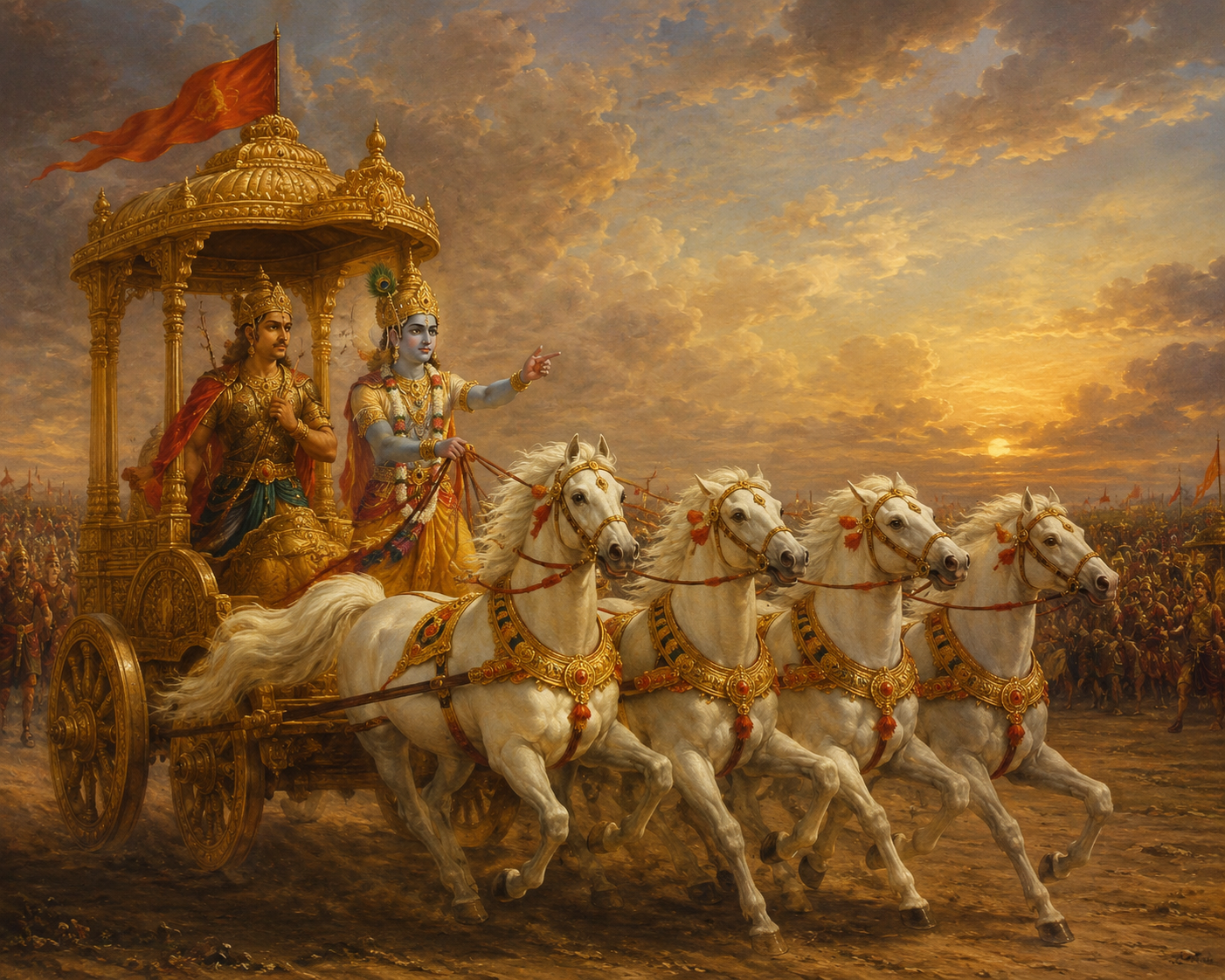
The Bhagavad Gītā's teachings on action, detachment, and the mind
Part 2 picks up where the opening of the Gītā left off — with Kṛṣṇa's great teaching on the mind in motion. From the chain of distraction that destroys clarity, through the cycle of yajña that sustains all life, to the paradox at the heart of meditation, Dr Bhat guides students through some of the Gītā's most practical and psychologically profound chapters. These teachings are not abstract philosophy — they are a precise map of how the human mind works, how desire leads to suffering, and how action performed with the right understanding becomes a form of liberation.
What you will learn in Part 2
How desire, distraction and anger erode the steadiness of the mind
The difference between the action that binds and the action that frees
The meaning of yajña — sacrifice — and how it applies to daily life
Why Kṛṣṇa acts in the world, and what this means for us
How the lineage of knowledge (parampara) preserves wisdom across time
The path of renunciation — and why Karma Yoga is greater
Course Format
12 Classes, On demand - learn at your own pace
Philosophical clarity rooted in traditional sources
Psychological insight into lived experience
Structured explanation of key concepts
Step-by-step unfolding of the text
Access to the course videos for 12 momths
Course Structure
-
Continuing from Chapter 2, Dr Bhat explains what it truly means to have a steady mind — prajñā. The pond and fish analogy and the lamp in still air illustrate how desires disturb the mind's natural clarity. Gītā 2.59 introduces the viṣaya-liga, and the Yoga Sūtra's distinction between painful and benign vṛttis is explored. The class ends with the famous chain: sensory contact → desire → anger → delusion → memory loss → loss of intellect → destruction.
-
Everything taken in through the senses — not just food — is āhāra. Association (saṅgat) is the second great trigger for distraction. Dr Bhat explains smṛti-bhraṁśa (memory loss) and buddhi-nāśa (loss of intellect) before arriving at the verse's resolution: nāsti śāntiḥ — there is no peace — and its opposite, prasāda — the clarity of a truly settled mind. The three types of karma and three types of karmic impression are introduced.
-
Chapter 3 opens with Arjuna's famous challenge to Kṛṣṇa — and Dr Bhat unpacks the concept of yajña in its fullest sense: not just fire ceremony but any purifying, selfless action. The great cycle from Gītā 3.14–15 is explored — beings arise from food, food from rain, rain from yajña, yajña from karma, karma from Brahman — and the warning of Gītā 3.16 is heard: one who does not participate in this wheel lives in vain.
-
The concept of karma-bandha — the bondage of karma — is explained, and the liberating principle of āsakta (acting without attachment) is introduced. Gītā 3.8 — niyataṃ kuru karma — is unpacked. Janaka, the king who became a sage through action, is introduced as the Gītā's model of the responsible leader: one whose every action serves the welfare of the world (loka-saṃgraham).
-
Gītā 3.22 — na me Pārtha — Kṛṣṇa declaring that he has nothing to gain and yet continues to act. Śaṅkarācārya worshipping an image despite knowing Brahman directly shows why even the liberated must act for others. The stories behind Kṛṣṇa's life are explored as illustrations of action guided entirely by dharma, not personal desire.
-
Desire, the Senses and the Avatāra Gītā 3.40 traces the path of desire through the senses, into the mind, and finally to the buddhi — where it creates mahā-moha (great delusion). Moving into Chapter 4, the teaching of yadā yadā hi dharmasya reveals why Kṛṣṇa takes form in the world. The story of Hiraṇyakaśipu, Prahlāda and the Narasiṃha avatāra brings this teaching memorably to life.
-
Chapter 4 begins with Kṛṣṇa explaining that this teaching is not new — it was transmitted from the beginning through parampara, the lineage of knowledge. Dr Bhat explores how a teaching lives through its lineage, why knowledge dilutes across generations, and how the Gītā itself is offered as a means of restoring it. The four-fold division of society (chatur-varṇa) is introduced.
-
A thorough explanation of the four categories — Brāhmaṇa, Kṣatriya, Vaiśya and Śūdra — established by quality and action, not birth. Each category carries a distinct duty and a distinct relationship with the world. The tree and its roots serve as an analogy for a spiritual practice that must remain continuous, grounded, and alive.
-
Gītā 4.24 — brahma-arpaṇam brahma havir — is explored as both a sacred mantra and a philosophical statement: when everything is understood as Brahman, even the act of eating becomes a form of offering. The many different types of yajña described in Chapter 4 reveal how vast and inclusive the concept truly is.
-
Chapter 5 addresses Arjuna's confusion: should he renounce or should he act? Dr Bhat clarifies that both paths lead to liberation — but Karma Yoga is greatest, because true renunciation is inner, not outer. The verse yo na dveṣṭi na kāṅkṣati (Gītā 5.3) defines the real sannyāsī, and the teaching is grounded in the everyday experience of seeking comfort.
-
The Lotus Leaf and Acting Without Attachment A deeply practical class drawing on Chapter 5 and the lotus leaf analogy: the leaf rests in water but is never wetted by it. Full engagement with the world — and complete freedom from being defined by it. Dr Bhat highlights Chapter 5 as especially valuable for psychological clarity, spiritual counselling, and the deepening of practice.
-
Chapter 6 opens with a crucial clarification: in this chapter, Ātmā means mind, not soul. According to Patañjali, dhyāna means focusing the mind on one object, and yet the harder you try to force it, the more the mind escapes. This paradox is the doorway into the chapter's deeper teaching on how to work with the mind naturally rather than against it.
By the end of Part 2, you will have:
A clear understanding of how the mind falls into distraction and how it recovers
A lived sense of what it means to act without attachment
A deep familiarity with the concept of yajña and how it applies to daily life
An understanding of the parampara tradition and why it matters
A firm grounding in Chapters 2 through 6 of the Bhagavad Gītā
The tools to begin reflecting these teachings in your own experience
Your Teacher
Dr Vigneshwar Bhat
Dr. Vigneshwar Bhat was born and raised in Karnataka. He holds a Ph.D. in Karma Meemamsa from Karnataka Sanskrit University. He earned gold medals for his M.A. degrees in Poorvameemamsa Vidwat Uttama and Sahitya Acharya from Rashtriya Sanskrit Vidyapeetha, Tirupati. His expertise extends to Śauta, Smārta, Tāntrik, and Paurāṇik rituals, and he is a Vedic priest and professor.
His research interests include Indian Philosophy, Yoga, Vedas, Sanskrit, and Indian Culture and Traditions. Dr. Bhat has authored numerous papers and books, shedding light on the profound wisdom of ancient scriptures.

Begin Part 2: Karma, Yajña & the Steady Mind
12 structured on-demand classes. Self-paced learning. A deep but accessible entry into the Bhagavad Gītā.
Karma, Yajña & the Steady Mind
12 x 1-hour structured classes with Dr Vigneshwar Bhat
Part 2 explores the Bhagavad Gītā's foundational teachings on action, sacrifice, and inner steadiness. Moving through Chapters 2 to 6, the course reveals how right action, performed without attachment and offered as yajña, becomes the path to a truly free and purposeful life.
Expert-led • structured • self-paced learning