
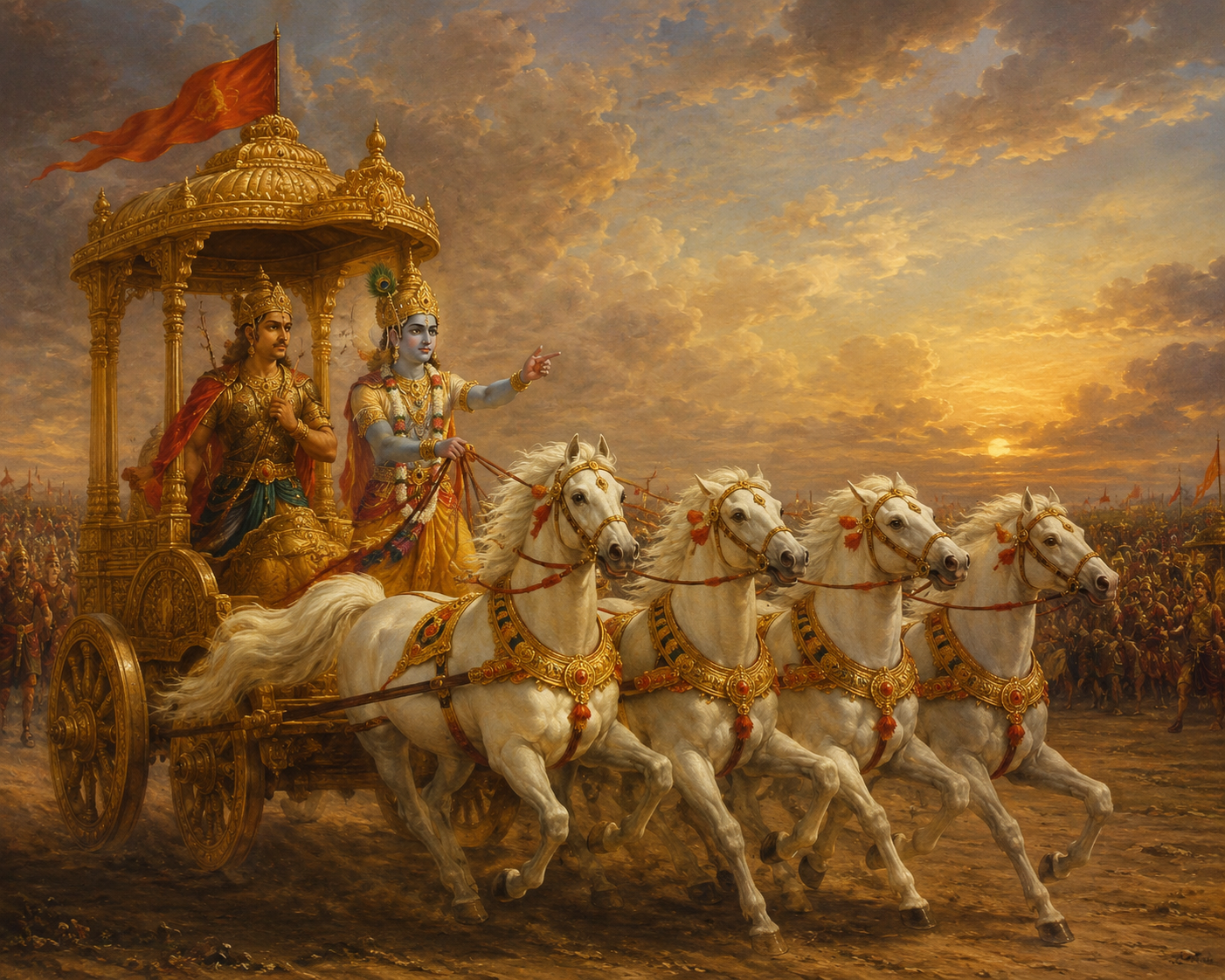
A Manual for Understanding Life
The Bhagavad Gītā can be understood as a practical manual for understanding human life. It is not simply a religious or philosophical text, but a structured inquiry into how we navigate the mind, emotions, action, and inner conflict. Like a user guide for life, it offers a way to bring clarity to what is often experienced as confusion, uncertainty, or struggle.
This 12-class foundational course introduces the Bhagavad Gītā in a clear and systematic way. It begins with the text's context and meaning, explores its core philosophical framework, and gradually unfolds key teachings on the Self (Ātmā), knowledge, action, suffering, and inner steadiness. Alongside traditional commentary, the teaching is grounded in lived experience and practical reflection, making the ideas accessible and applicable rather than purely theoretical.
The course is designed for yoga teachers, practitioners, and students of philosophy who want a structured and authentic entry into the Bhagavad Gītā. It provides the essential foundation for understanding the text as a whole, while also offering direct insight into how its teachings relate to everyday life and inner experience.
What you will learn in Part 1
A clear understanding of what the Bhagavad Gītā actually is
A structured way to approach philosophical texts
A full overview of all 18 chapters before detailed study
Foundational teachings on the Self (Ātmā), karma, and suffering
A framework for interpreting inner experience with clarity
Course Format
12 Classes, On demand - learn at your own pace
Philosophical clarity rooted in traditional sources
Psychological insight into lived experience
Structured explanation of key concepts
Step-by-step unfolding of the text
Access to the course videos for 12 momths
Course Structure
-
An orientation to the course and the text itself. Dr Vigneshwar Bhat explains the right approach to studying philosophy—not passively, but through questioning and practice. The title is unpacked word by word (Bhaga, Gītā), the text is placed within the Prasthānatrayī, and its traditional names are introduced. A foundational entry point into the Gītā.
-
Explores Brahmavidyā and Yoga Śāstra, and the meaning of Yoga through Patañjali and Vyāsa. Introduces Parā Vidyā and Aparā Vidyā. The class concludes with the six essential qualities for study: Śama, Dama, Uparati, Titikṣā, Śraddhā, and Samādhāna.
-
Introduces the Mahābhārata context and the events leading to Kurukṣetra. Provides a complete overview of all 18 chapters of the Gītā, showing how the text is structured and how each part connects.
-
Explores the guru–śiṣya tradition and Kṛṣṇa as Jagadguru. Arjuna arrives confident, sees family and teachers on both sides, and collapses into confusion and crisis. A deeply human entry into the teaching.
-
A detailed reading of Arjuna’s arguments and breakdown. Themes include dharma conflict, moha, lobha, saṅga, and kula-dharma. Introduces Sṛṣṭi–Dṛṣṭi and closes with Arjuna’s total surrender, laying down his weapons before Kṛṣṇa.
-
Introduction to Sāṃkhya / Jñāna Yoga. Explores why steadiness of mind is essential before receiving teaching. Includes Arjuna’s surrender as readiness for guidance, and the role of the guru in removing ignorance.
-
A deep exploration of the Ātmā. Covers the three bodies (sthūla, sūkṣma, kāraṇa), sleep as daily dissolution, and continuity beyond death. Key analogies: pot and space, and changing clothes (vāsāṃsi jīrṇāni).
-
Clarifies subtle questions on consciousness and scriptural language. Explores saṃskāras, the causal body, and symbolic descriptions of the Self. Includes a discussion on depression through perception, conditioning, and modern life.
-
-
Explores how clarity develops through action. Traces the progression from skill → balance → steadiness → success → freedom. Includes Gītā 2.50 and 2.54–2.55, and teachings on the person of steady wisdom.
-
Focuses on sthiti (steadiness) as the core of yoga. Each limb of Aṣṭāṅga Yoga is reframed as steadiness in body, breath, senses, mind, attention, and awareness. Progress is measured by stability, not duration of practice.
-
Explores how to determine right action using Śruti, Smṛti, Sadācāra, and Ātma-priyatva. Discusses suffering as perception and ignorance. Examines karma as purification, including why practice may intensify inner process.
By the end of Part 1, you will have:
A clear conceptual map of the Bhagavad Gītā
Understanding of its core philosophical foundations
A framework for interpreting life experience
Readiness for deeper study in Parts 2–4
Your Teacher
Dr Vigneshwar Bhat
Dr. Vigneshwar Bhat was born and raised in Karnataka. He holds a Ph.D. in Karma Meemamsa from Karnataka Sanskrit University. He earned gold medals for his M.A. degrees in Poorvameemamsa Vidwat Uttama and Sahitya Acharya from Rashtriya Sanskrit Vidyapeetha, Tirupati. His expertise extends to Śauta, Smārta, Tāntrik, and Paurāṇik rituals, and he is a Vedic priest and professor.
His research interests include Indian Philosophy, Yoga, Vedas, Sanskrit, and Indian Culture and Traditions. Dr. Bhat has authored numerous papers and books, shedding light on the profound wisdom of ancient scriptures.

Begin Part 1: Foundations
12 structured on-demand classes. Self-paced learning. A deep but accessible entry into the Bhagavad Gītā.
Foundations of Inner Understanding
12 x 1-hour structured classes with Dr Vigneshwar Bhat
The Bhagavad Gītā is not only a philosophical text, but a structured inquiry into how human life is understood and lived. This course offers a clear, guided entry into its teachings—unfolding the foundations of consciousness, action, and inner clarity.
Expert-led • structured • self-paced learning